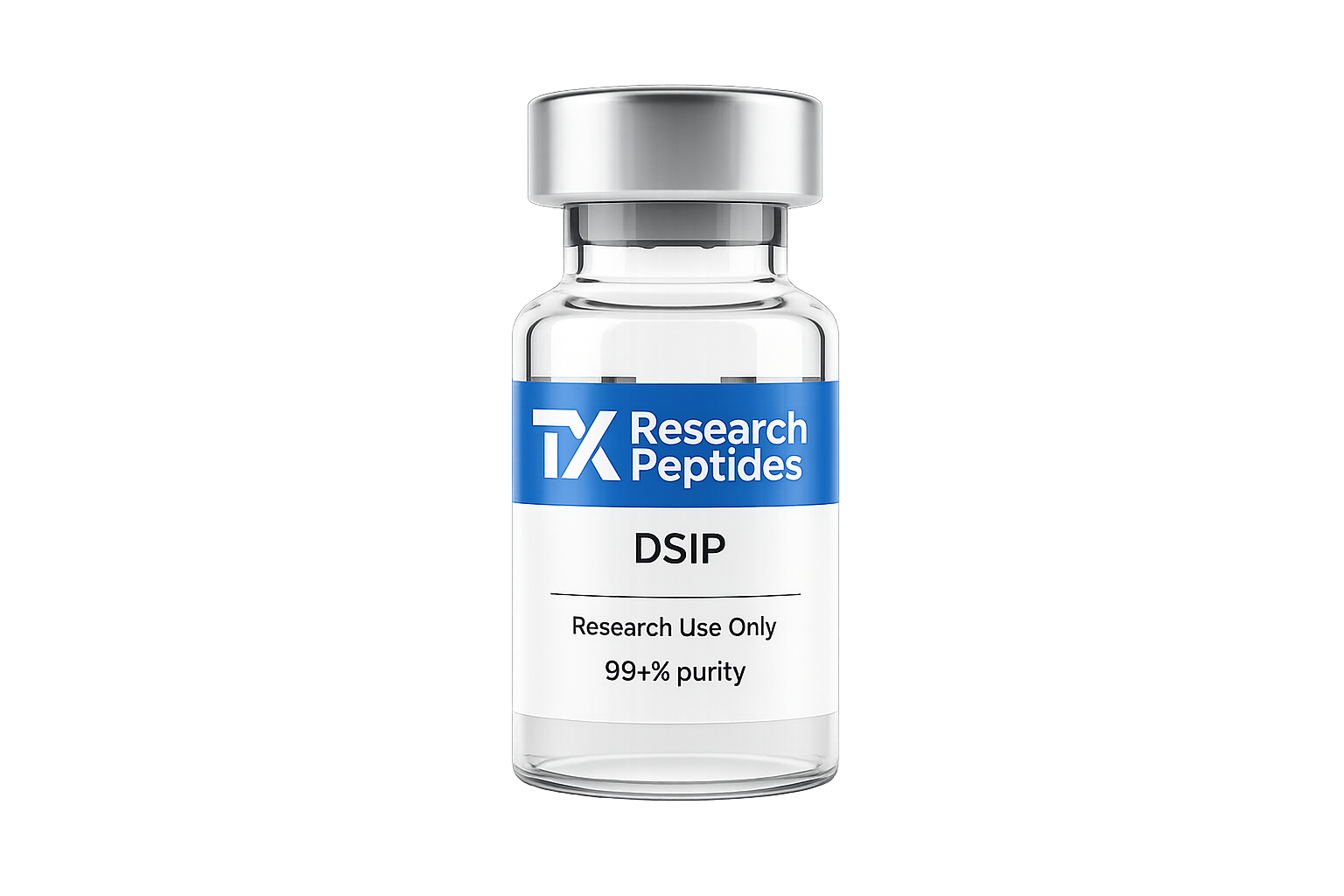
 ≥99% Purity
Cognitive & Longevity
DSIP
Delta sleep-inducing peptide for sleep-architecture research.
Strength
💰 Mix & match bundle pricing
5+ vials 15% off · 10+ vials 25% off
Any mix of products counts — the discount applies to your whole cart at checkout. (Supplies like bacteriostatic water don't count.)
Need larger volumes? Bulk & wholesale pricing available — apply for wholesale.
About this compound
Molecular Specifications
DSIP (Delta Sleep-Inducing Peptide) is an endogenous neuropeptide first isolated from the cerebral venous blood of sleeping rabbits in 1977 by Schoenenberger and Monnier at the University of Basel. The nonapeptide sequence Trp-Ala-Gly-Gly-Asp-Ala-Ser-Gly-Glu was subsequently characterized, synthesized, and studied in sleep architecture, neuroendocrinology, and stress biology research across multiple animal model systems.
Sleep Architecture Research
DSIP was named for its association with induction of slow-wave (delta) sleep in early animal studies. Administration to sleeping rabbits produced increased delta EEG activity — the electrical signature of deep NREM sleep. Subsequent research has examined DSIP's effects on slow-wave sleep duration and architecture, sleep-wake cycle timing, and EEG power spectrum changes during sleep.
↗ Schoenenberger GA, Monnier M. (1977). Characterization of a delta-EEG-inducing peptide. PNAS. PubMed: 412239
HPA Axis and Stress Biology
Beyond sleep research, DSIP has been investigated for interactions with the hypothalamic-pituitary-adrenal (HPA) axis in animal models, including effects on CRH and ACTH release, corticosterone secretion patterns, and stress-induced HPA axis activation — making it relevant to stress biology and psychoneuroendocrinology research.
Research Applications
- Sleep architecture and delta-wave EEG research in animal models
- NREM sleep regulatory mechanism investigation
- HPA axis biology and corticosterone secretion studies
- Neuropeptide receptor pharmacology
- Circadian rhythm and sleep-wake cycle research
- Stress response neuroendocrinology
Storage & Handling
Store lyophilized powder at −20°C for long-term stability; short-term 2–8°C is acceptable. Reconstitute with bacteriostatic water; keep refrigerated at 2–8°C after reconstitution and use within typical research timelines.
For laboratory and research use only. Not for human or veterinary use, diagnostic, or therapeutic applications. Statements have not been evaluated by the FDA.
Research Disclaimer: The information below is provided for laboratory and research-use-only educational purposes. It is not medical advice. DSIP is not intended for human or veterinary use, diagnosis, or therapy, and statements have not been evaluated by the FDA.
Compound Overview
What is DSIP?
Research Applications
DSIP in research models
Mechanism of Action
Receptor & pathway interactions studied
Purity & Testing
HPLC + mass-spec verification
Storage & Reconstitution
Handling lyophilized peptides
Researchers typically reconstitute with bacteriostatic water. Browse research supplies →
Frequently Asked
DSIP research FAQ
What purity is DSIP tested to?+
Every batch of DSIP is tested by HPLC for purity (≥99% by area) and confirmed by mass spectrometry. The lot-specific Certificate of Analysis is available on this product page.
Is DSIP intended for human use?+
No. DSIP is supplied strictly for laboratory and research-use-only investigation. It is not intended for human or veterinary use, diagnosis, or therapy.
How should DSIP be stored?+
Store the lyophilized powder at −20°C for long-term stability. After reconstitution with bacteriostatic water, store at 2–8°C and use within typical research timelines.
Do you ship within the United States?+
Yes. TX Research Peptides ships DSIP domestically within the US with flat-rate shipping. Orders ship from the US for fast delivery to research labs.
Continue researching
Related compounds
Customer Reviews
What researchers say about DSIP
—
Be the first to review
Loading reviews…
Related Compounds