Research Guides
RT3 – GLP3 Research Overview | Triple-Agonist Mechanism | TX Research Peptides
About the author: The TX Research Peptides editorial team curates research-use-only educational content reviewed for accuracy against published preclinical and clinical literature. All articles are framed strictly for laboratory research and are not medical advice.
Part of the pillar guide.
Research Disclaimer: Research-use-only educational content. Not medical advice. This material is not for human or veterinary use. References to clinical research describe studies conducted by the molecule's developers, not any use of this research-grade material.
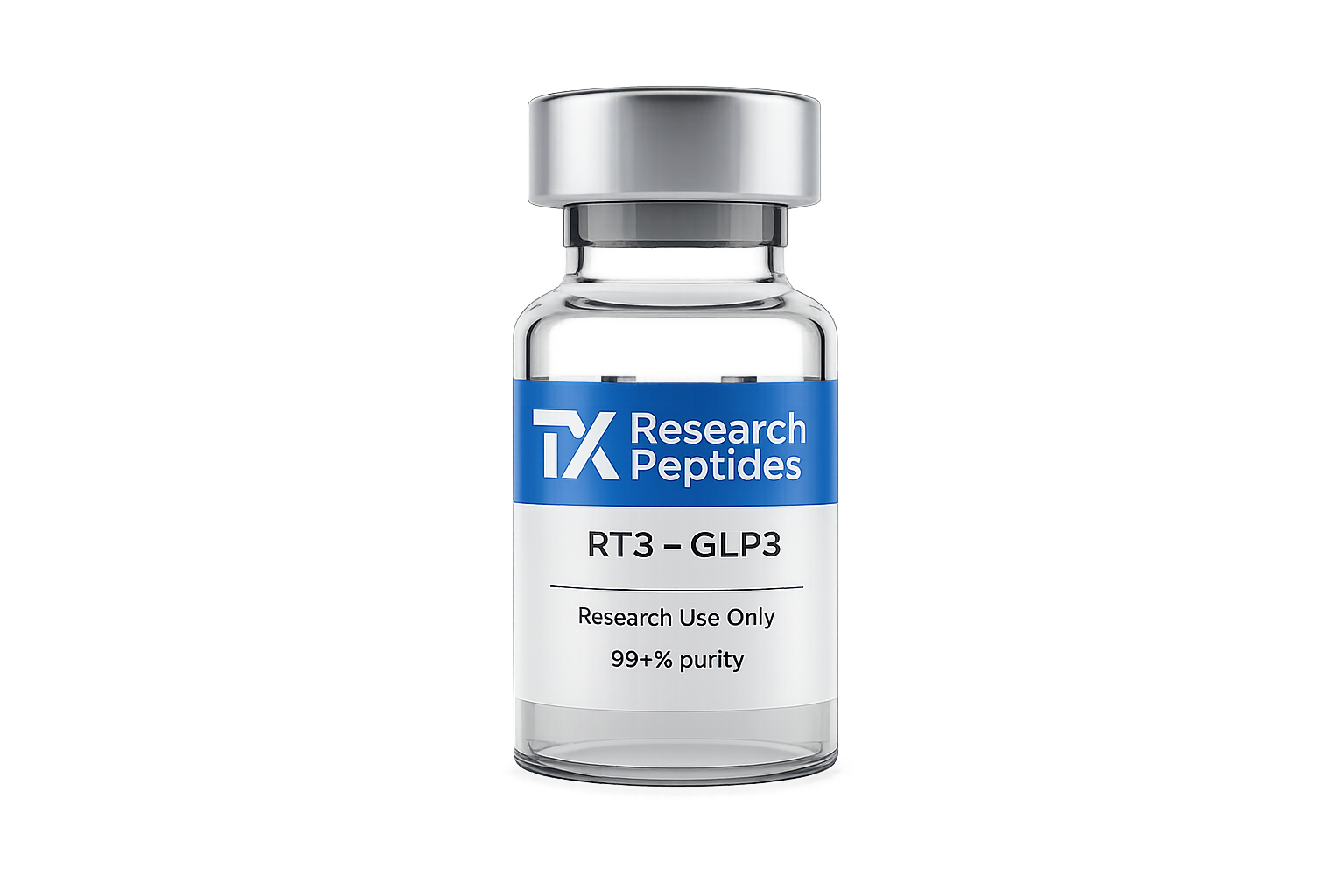
What Is RT3 – GLP3?
RT3 – GLP3 (developmental designation LY3437943) is a single-molecule triple receptor agonist acting at the GIP, GLP-1, and glucagon receptors. It is studied in metabolic-research contexts as a next-generation incretin-class molecule.
It is supplied as a lyophilized (freeze-dried) powder for laboratory research use only.
Published Research Overview
Unlike many research peptides, RT3 – GLP3 has been the subject of clinical research conducted by its pharmaceutical developer (published Phase-2 metabolic studies, including obesity and type-2 diabetes endpoints). This material is nonetheless supplied strictly for laboratory research use only and is not for human use. The clinical literature is referenced here only to describe the molecule's studied mechanism and pharmacology, not as guidance for any human application of this research-grade material.
Proposed Mechanism of Action (as studied)
- Simultaneous agonism at three metabolic/incretin receptors — GIP, GLP-1, and glucagon — distinguishing RT3 – GLP3 from single-agonist (e.g., GLP-1-only) and dual-agonist molecules.
- Studied for combined effects on glycemic and energy-balance pathways in the published developer literature.
These are described as the molecule's pharmacology as reported in published research, not as established clinical guidance for use of this material.
Storage & Reconstitution (laboratory handling)
- Lyophilized storage: keep the sealed vial cold and protected from light; long-term storage at freezer temperatures per the COA/handling guidance.
- After reconstitution: once reconstituted with bacteriostatic water, store refrigerated and use within the window indicated by your handling protocol.
- Reconstitution: bacteriostatic water is the common diluent; the volume used determines the concentration of the resulting solution. See our Supplies & Reconstitution category for bacteriostatic water.
This is concentration guidance for laboratory handling only — not a human dose.
How to Choose a Quality Research Source
Because peptide purity varies significantly between suppliers, researchers should evaluate:
- Independent third-party testing — HPLC for purity and mass spectrometry for identity, performed by a named lab (e.g., Janoshik Analytical).
- Batch-specific COAs — published and verifiable before purchase, not generic.
- Transparent purity standard — a stated minimum (we test to ≥99%).
- Proper handling and cold-chain — appropriate packaging and storage.
At TX Research Peptides, every batch is independently tested and the COA is available in our COA Library.
Citations & references
Frequently asked questions
Is this product for human use?+
No. It is supplied for laboratory research use only and is not approved for human or veterinary use.
What makes RT3 – GLP3 different from GLP-1 (S) or TZ2 – GLP2?+
RT3 – GLP3 is studied as a triple receptor agonist at GIP, GLP-1, and glucagon receptors, whereas GLP-1 (S) is a GLP-1 single agonist and TZ2 – GLP2 is a GIP/GLP-1 dual agonist.
Has RT3 – GLP3 been in clinical trials?+
Yes — the molecule has been studied in developer-sponsored clinical research (including Phase-2 obesity and type-2 diabetes studies). That literature describes the molecule’s pharmacology and is not guidance for use of this research-grade material.
How is identity verified?+
Independent mass spectrometry for identity and HPLC for purity, documented in a batch-specific Certificate of Analysis.
Continue reading
Research Guides
TB-500 Research Guide | Thymosin Beta-4 Studies & Handling | TX Research Peptides
Research-use-only overview of TB-500: relationship to Thymosin Beta-4, preclinical study areas, proposed mechanisms, and laboratory storage. For research use only.
Research Guides
BPC-157 Research Guide | Mechanism, Studies & Handling | TX Research Peptides
A research-use-only overview of BPC-157: what it is, what preclinical studies have examined, its proposed mechanisms, and proper laboratory storage and reconstitution. For research use only.
Research Guides
GHK-Cu Research Guide | Copper Peptide Studies & Handling | TX Research Peptides
Research-use-only overview of GHK-Cu (copper tripeptide-1): dermal and connective-tissue research areas, proposed mechanisms, and lab handling. For research use only.
Buyer's Guides
Research Peptides in Austin, TX | Same-State Dispatch | TX Research Peptides
Sourcing research-use-only peptides in Austin, Texas: same-state shipping, independent HPLC/MS testing, and batch COAs from a Texas-based supplier.
Buyer's Guides
Research Peptides in Texas | US-Based, Third-Party Tested | TX Research Peptides
A guide to sourcing research-use-only peptides in Texas: same-state dispatch, independent HPLC/MS testing, and batch COAs from a genuinely Texas-based supplier.