Research Guides
GHK-Cu Research Guide | Copper Peptide Studies & Handling | TX Research Peptides
About the author: The TX Research Peptides editorial team curates research-use-only educational content reviewed for accuracy against published preclinical literature. All articles are framed strictly for laboratory research and are not medical advice.
Part of the pillar guide.
Research Disclaimer: Research-use-only educational content. Not medical advice. GHK-Cu is not approved for human or veterinary use, and nothing here should be interpreted as a recommendation for such use.
What Is GHK-Cu?
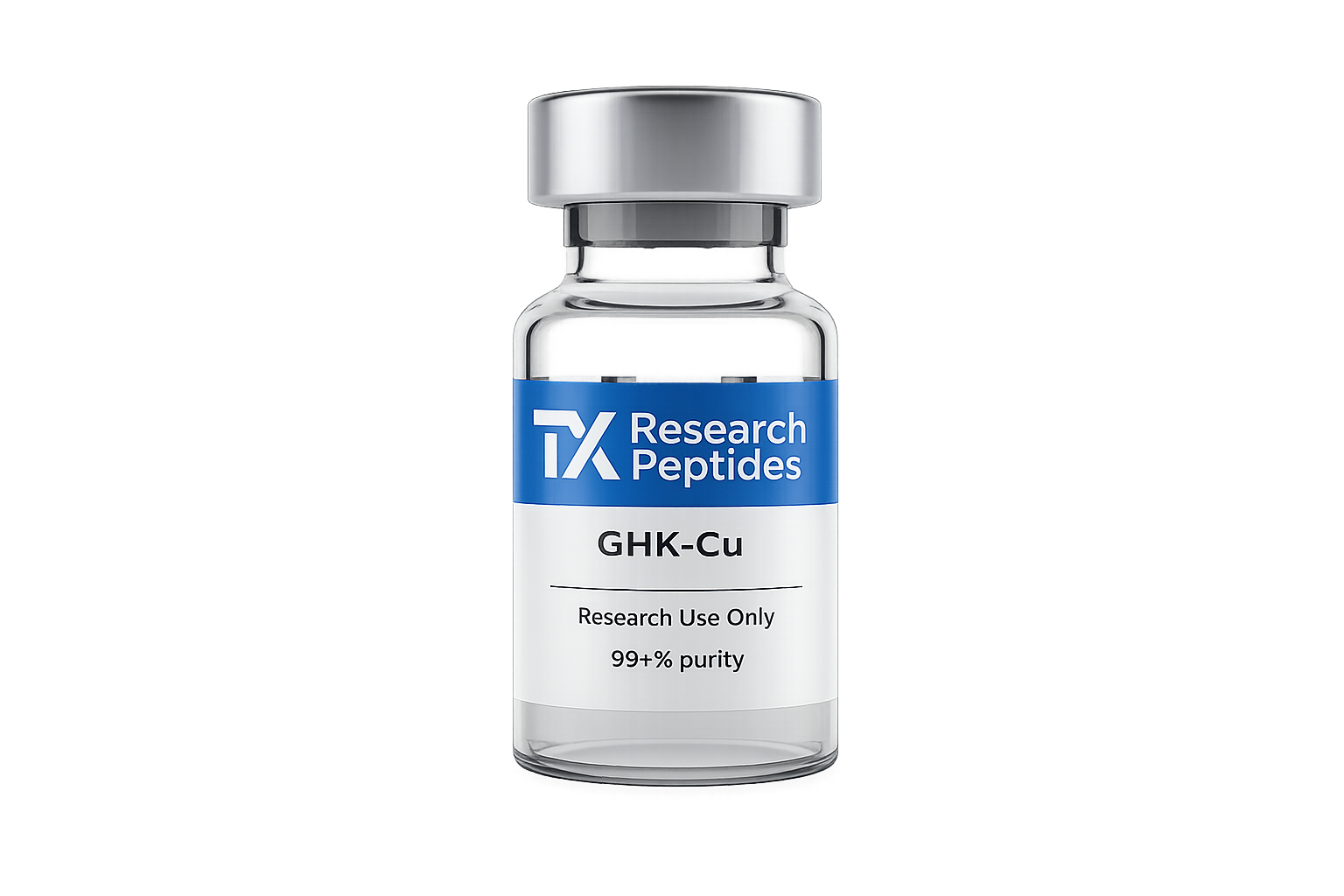
GHK-Cu is a copper-binding tripeptide — glycyl-L-histidyl-L-lysine complexed with copper(II). It is a widely studied model peptide in dermatological and connective-tissue research, much of it associated with the work of Loren Pickart and colleagues.
It is supplied as a lyophilized (freeze-dried) powder for laboratory research use only.
Published Research Overview
The GHK-Cu literature is largely in-vitro, topical, and animal-model. Reported study areas include:
- Collagen and extracellular-matrix (ECM) gene-expression models
- Antioxidant-activity assays
- Skin-remodeling and wound-research models
- Cosmetic-science formulation research
There is no large controlled human clinical-trial body for GHK-Cu as a research peptide; preclinical and in-vitro results do not establish safety or effect in humans.
Proposed Mechanisms of Action (as studied)
- Modulation of collagen/ECM-related gene expression — observed across dermal and connective-tissue models.
- Copper transport — GHK acts as a copper-binding carrier in biochemical assays.
- Antioxidant signaling — examined in oxidative-stress in-vitro models.
These are described as research observations, not established clinical mechanisms.
Storage & Reconstitution (laboratory handling)
- Lyophilized storage: keep the sealed vial cold and protected from light; long-term storage at freezer temperatures per the COA/handling guidance.
- After reconstitution: once reconstituted with bacteriostatic water, store refrigerated and use within the window indicated by your handling protocol.
- Reconstitution: bacteriostatic water is the common diluent for laboratory reconstitution; the volume used determines the concentration of the resulting solution. See our Supplies & Reconstitution category for bacteriostatic water.
This is concentration guidance for laboratory handling only — not a human dose.
How to Choose a Quality Research Source
Because peptide purity varies significantly between suppliers, researchers should evaluate:
- Independent third-party testing — HPLC for purity and mass spectrometry for identity, performed by a named lab (e.g., Janoshik Analytical).
- Batch-specific COAs — published and verifiable before purchase, not generic.
- Transparent purity standard — a stated minimum (we test to ≥99%).
- Proper handling and cold-chain — appropriate packaging and storage.
At TX Research Peptides, every batch is independently tested and the COA is available in our COA Library.
Citations & references
Frequently asked questions
Is GHK-Cu approved for human use?+
No. GHK-Cu is a research compound supplied for laboratory research use only and is not approved for human or veterinary use.
What field studies GHK-Cu most?+
Dermal and connective-tissue research, cosmetic-science formulation research, and wound-research models — primarily in-vitro and animal studies.
How is GHK-Cu stored?+
Lyophilized vials are stored cold and dark; refrigerate after reconstitution with bacteriostatic water per the lab handling guidance on the product COA.
How is purity verified?+
Independent HPLC and mass-spectrometry testing with a batch-specific Certificate of Analysis, made available before purchase.
Continue reading
Research Guides
TB-500 Research Guide | Thymosin Beta-4 Studies & Handling | TX Research Peptides
Research-use-only overview of TB-500: relationship to Thymosin Beta-4, preclinical study areas, proposed mechanisms, and laboratory storage. For research use only.
Research Guides
BPC-157 Research Guide | Mechanism, Studies & Handling | TX Research Peptides
A research-use-only overview of BPC-157: what it is, what preclinical studies have examined, its proposed mechanisms, and proper laboratory storage and reconstitution. For research use only.
Buyer's Guides
Research Peptides in Austin, TX | Same-State Dispatch | TX Research Peptides
Sourcing research-use-only peptides in Austin, Texas: same-state shipping, independent HPLC/MS testing, and batch COAs from a Texas-based supplier.
Buyer's Guides
Research Peptides in Texas | US-Based, Third-Party Tested | TX Research Peptides
A guide to sourcing research-use-only peptides in Texas: same-state dispatch, independent HPLC/MS testing, and batch COAs from a genuinely Texas-based supplier.
Buyer's Guides
Research Peptides in Houston, TX | Same-State Dispatch | TX Research Peptides
Sourcing research-use-only peptides in Houston, Texas: same-state shipping, independent HPLC/MS testing, and batch COAs from a Texas-based supplier.