Research Guides
BPC-157 Research Guide | Mechanism, Studies & Handling | TX Research Peptides
About the author: The TX Research Peptides editorial team curates research-use-only educational content reviewed for accuracy against published preclinical literature. All articles are framed strictly for laboratory research and are not medical advice.
Part of the pillar guide.
Research Disclaimer: This article is for laboratory and research-use-only educational purposes. It is not medical advice. BPC-157 is not approved for human or veterinary use, and nothing here should be interpreted as a recommendation for use in humans or animals.
What Is BPC-157?
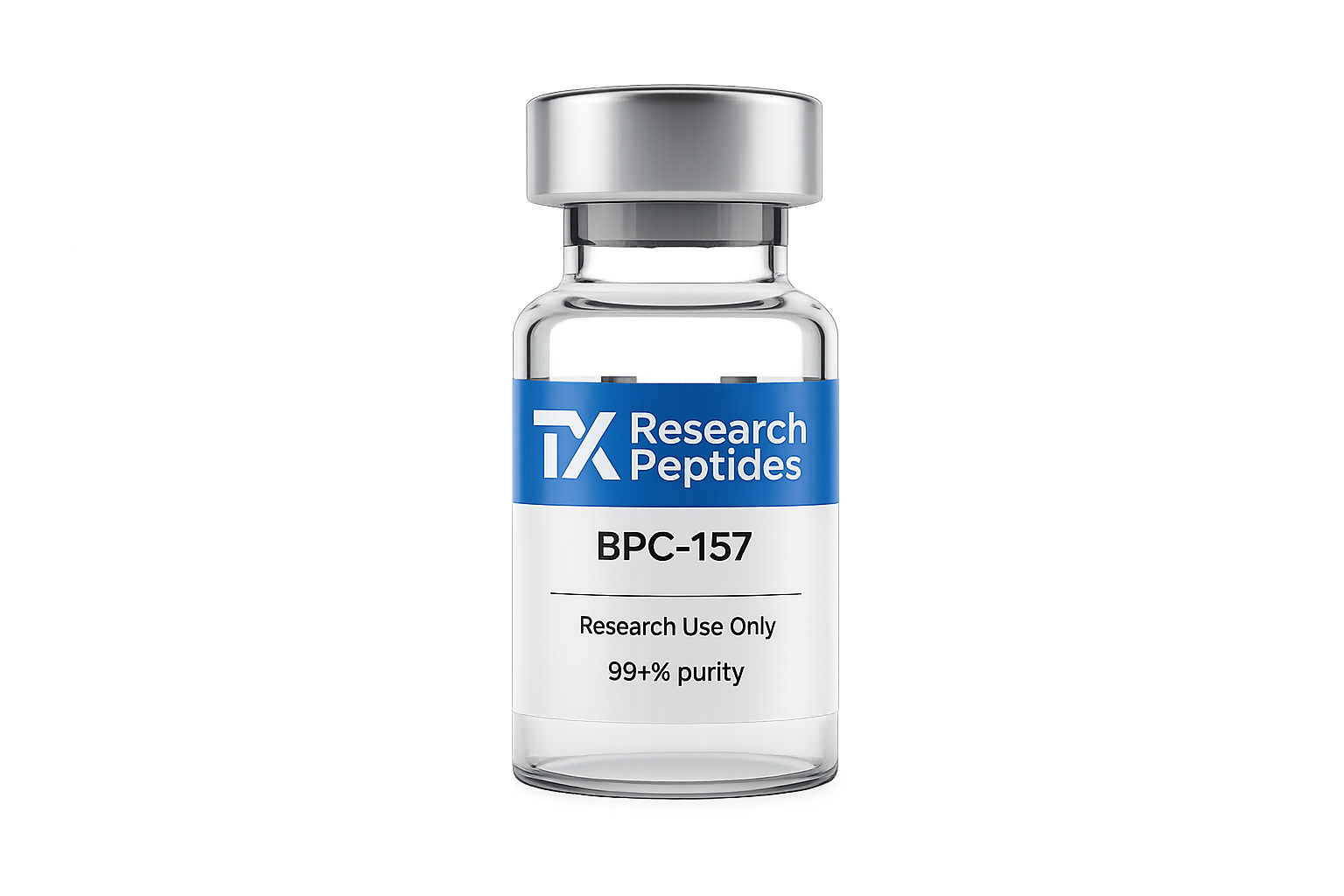
BPC-157 is a synthetic, stable pentadecapeptide — a chain of 15 amino acids — derived from a partial sequence of a protein (often referred to as Body Protection Compound) originally identified in gastric juice. In the research literature it is studied as a model peptide for tissue-repair and cytoprotection pathways. It is notable to researchers for its reported stability in gastric acid, which is unusual among peptides and is one reason it has been used widely in preclinical experimental models.
In a research catalog, BPC-157 is classified as a cytoprotective research compound and is supplied as a lyophilized (freeze-dried) powder for laboratory use only.
Published Research Overview
The large majority of BPC-157 literature consists of animal-model (rodent) and in-vitro studies, much of it associated with the research group of Predrag Sikiric and colleagues. Reported lines of investigation include models of tendon, ligament, muscle, and bone injury; gastrointestinal mucosal models (including ulcer and inflammatory bowel models); and vascular/angiogenesis studies.
It is important for researchers to understand that these are preclinical findings — there is no body of large, controlled human clinical-trial data, and results in animal models do not establish safety or effect in humans.
Proposed Mechanisms of Action (as studied)
Across the preclinical literature, several mechanisms have been proposed and examined:
- Angiogenesis / VEGFR2 signaling — studies describe effects on blood-vessel formation pathways, frequently via vascular endothelial growth factor receptor 2.
- Nitric oxide (NO) system modulation — interactions with NO synthesis pathways are a recurring theme.
- Growth-factor and gene-expression effects — including pathways associated with collagen and connective-tissue organization in injury models.
- Gut–brain axis signaling — a number of studies examine systemic signaling originating in the GI tract.
These are described as research observations, not established clinical mechanisms.
Dosing as Studied in Research
In published animal studies, dosing is typically reported on a per-kilogram basis in research models and varies widely by study design, route, and species. These figures describe experimental protocols in the literature and are provided only as a summary of how studies were structured — they are not instructions and do not translate to any human or veterinary use. Researchers designing experiments should refer to the specific primary literature relevant to their model.
Storage & Reconstitution (laboratory handling)
- Lyophilized storage: keep the sealed vial cold and protected from light; long-term storage is typically at freezer temperatures per the COA/handling guidance.
- After reconstitution: once reconstituted with bacteriostatic water, store refrigerated and use within the window indicated by your handling protocol.
- Reconstitution: bacteriostatic water is the common diluent for laboratory reconstitution; the volume used determines the concentration of the resulting solution. See our Supplies & Reconstitution category for bacteriostatic water.
This is concentration guidance for laboratory handling only — not a human dose.
How to Choose a Quality Research Source
Because peptide purity varies significantly between suppliers, researchers should evaluate:
- Independent third-party testing — HPLC for purity and mass spectrometry for identity, performed by a named lab (e.g., Janoshik Analytical).
- Batch-specific COAs — published and verifiable before purchase, not generic.
- Transparent purity standard — a stated minimum (we test to ≥99%).
- Proper handling and cold-chain — appropriate packaging and storage.
At TX Research Peptides, every batch is independently tested and the COA is available in our COA Library.
Citations & references
Frequently asked questions
Is BPC-157 approved for human use?+
No. It is a research compound supplied for laboratory research use only and is not approved for human or veterinary use.
What kind of studies exist on BPC-157?+
Predominantly animal-model (rodent) and in-vitro preclinical studies; there is no large controlled human clinical-trial body of evidence.
How is BPC-157 stored?+
Lyophilized, cold and dark; refrigerated after reconstitution per the lab handling guidance on the product COA.
How is purity verified?+
Independent HPLC and mass-spectrometry testing with a batch-specific Certificate of Analysis, made available before purchase.
Continue reading
Buyer's Guides
Research Peptides in Austin, TX | Same-State Dispatch | TX Research Peptides
Sourcing research-use-only peptides in Austin, Texas: same-state shipping, independent HPLC/MS testing, and batch COAs from a Texas-based supplier.
Buyer's Guides
Research Peptides in Texas | US-Based, Third-Party Tested | TX Research Peptides
A guide to sourcing research-use-only peptides in Texas: same-state dispatch, independent HPLC/MS testing, and batch COAs from a genuinely Texas-based supplier.
Research Guides
TB-500 Research Guide | Thymosin Beta-4 Studies & Handling | TX Research Peptides
Research-use-only overview of TB-500: relationship to Thymosin Beta-4, preclinical study areas, proposed mechanisms, and laboratory storage. For research use only.
Buyer's Guides
Research Peptides in Houston, TX | Same-State Dispatch | TX Research Peptides
Sourcing research-use-only peptides in Houston, Texas: same-state shipping, independent HPLC/MS testing, and batch COAs from a Texas-based supplier.
Buyer's Guides
Research Peptides in Dallas, TX | Same-State Dispatch | TX Research Peptides
Sourcing research-use-only peptides in Dallas, Texas: same-state shipping, independent HPLC/MS testing, and batch COAs from a Texas-based supplier.